
Executive summary
During Watermark’s merger and rebrand, we shaped a next-generation assessment and accreditation platform for higher education. The opportunity was to make institutional planning and evidence collection easier to coordinate across a complex academic hierarchy.
The challenge
Assessment planning involves many people with distinct responsibilities, but the resulting evidence must still roll up into a coherent institutional story. The experience had to support local autonomy without losing shared visibility and accountability.
Role & strategy
My role
I led UX for Academic Planning, shaping the experience from research and problem definition through workflows, prototypes, and delivery.
- Conducted user research and created journey maps to clarify needs, identify opportunities, and guide product direction
- Defined a repeatable UX process, standardized design deliverables, and built an interaction-pattern library for reuse across the product
- Worked with cross-functional partners to turn complex planning tasks into more understandable product experiences
The strategic bet
We framed planning as a living collaboration system—not a collection of forms. Goals, contributors, evidence, and reporting cadence need to remain connected as work moves between institutional levels.
Selected decisions
Who we are designing for
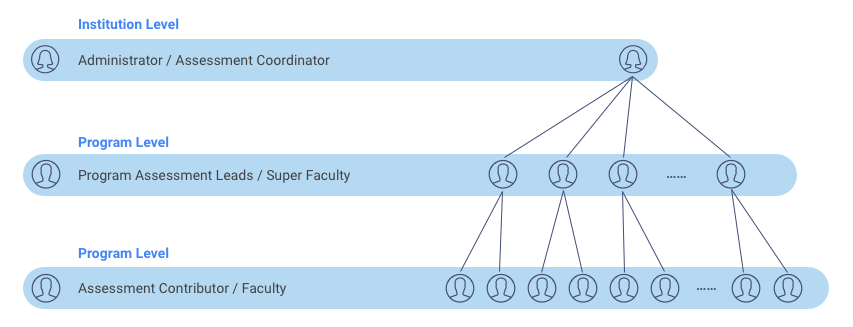
Universities and colleges usually have a multi-level organization hierachy. Assessment Coordinator or Unit Administrator in an institution is usaually the creator of assessment plans.
Each level has their goals and objectives. Assessment Leads are the contact people for each organization. They are responsible for entering the objectives assessment results during each assessment period. These assessment results can be rolled over to support higher level organization's objective assessment.
In each program, faculty members work as assessment contributors, to score students' assignments, work, performance and provide these data to their Assessment Lead.
When and How
The solution
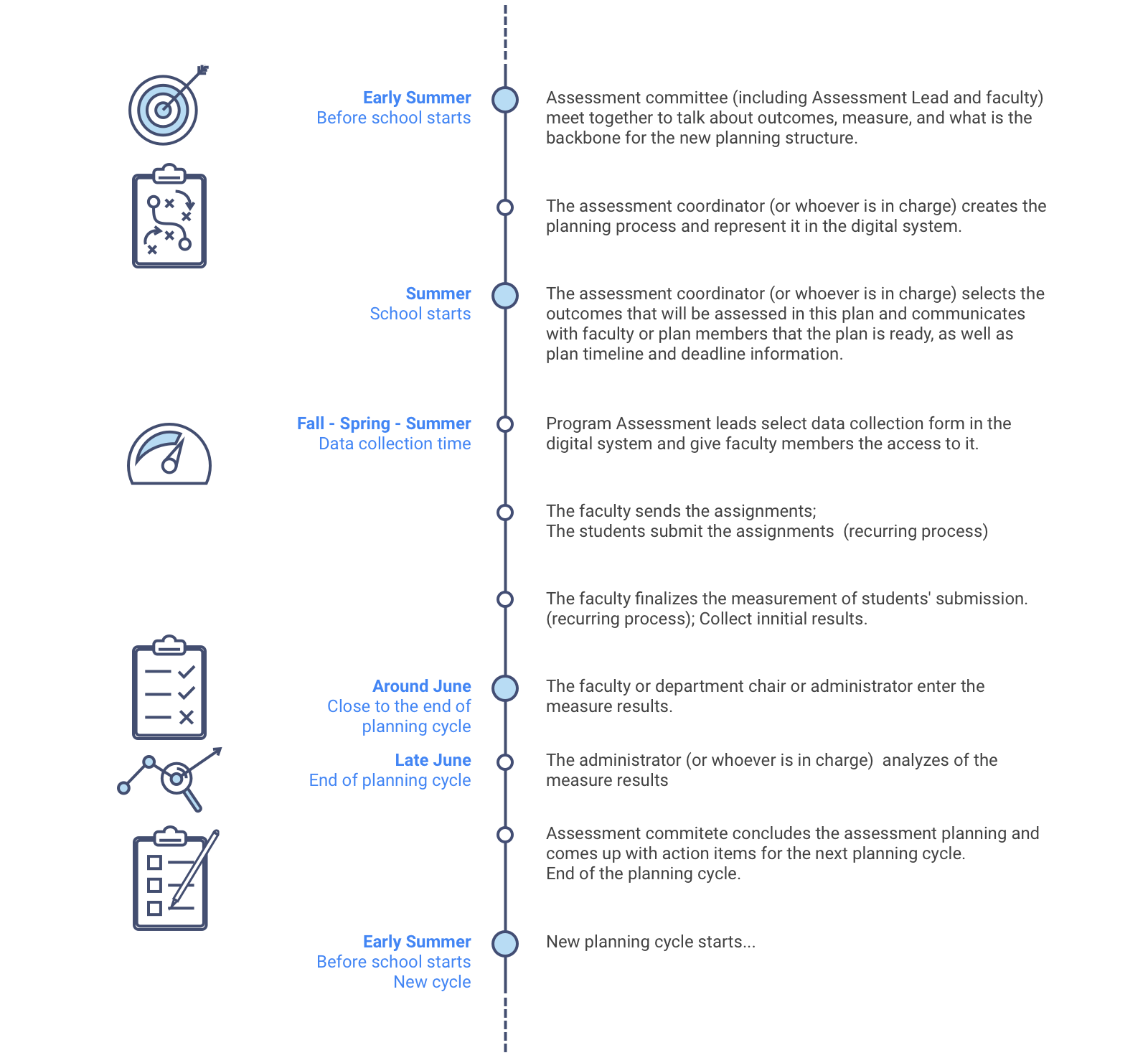
The proposed platform connects planning, evidence collection, and cross-level collaboration in a workflow designed to make assessment practice more sustainable and meaningful.
Outcomes & reflection
Leadership reflection: In multi-stakeholder systems, good UX makes ownership and handoffs visible. That is how design can improve the practice around a product, not just the product itself.
Selected supporting project document:
Full Project Document